


Why Climbing Is the Perfect Cross-Training Sport for Kids in Soccer, Gymnastics, and Wrestling
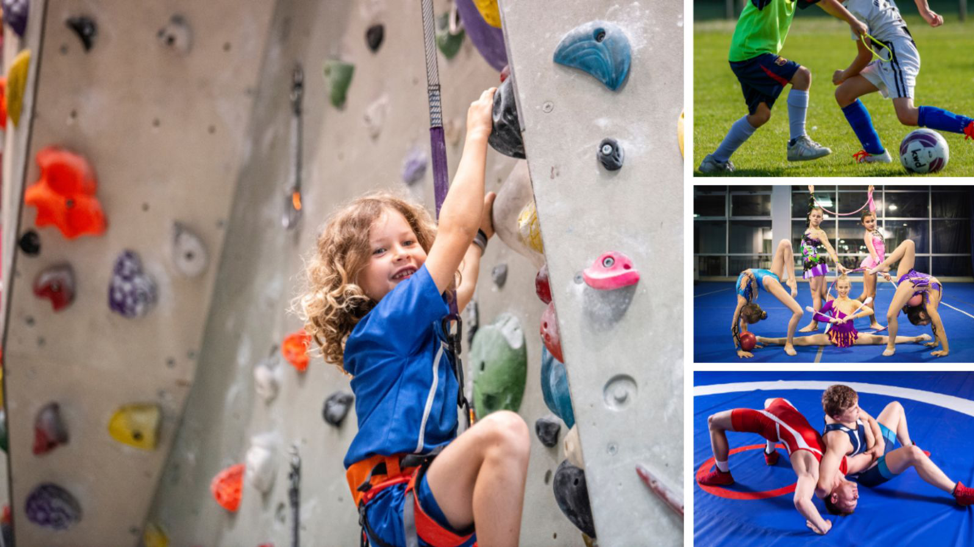
Climbing as cross-training for kids is a powerful form of physical activity that supports young athletes involved in other sports. Climbing builds full-body strength, improves balance, and reinforces efficient movement patterns that transfer directly to both athletic performance and everyday life.
Problem-solving skills and confidence, valuable traits in all competitive sports, are also major benefits of climbing. It offers a low-risk way for kids to challenge themselves mentally and physically, helping build resilience, focus, and self-trust. This makes climbing a strong addition to any well-rounded training routine.
The variety of climbing techniques supports athletes in sports like soccer, gymnastics, and wrestling by enhancing flexibility, coordination, and body control. Children who climb regularly often move more efficiently and may be less prone to injuries in their primary sports.
Physical and Mental Benefits of Climbing for Young Athletes
Climbing as cross-training for kids supports overall athletic development by improving how the body moves and how the mind responds to challenge.
Enhancing Strength and Coordination
Climbing engages nearly every muscle group in the body, strengthening the arms, legs, core, and back. This full-body workout is especially beneficial for young athletes who need both power and endurance in their main sports.
Coordination improves because climbing requires hands and feet to move in sync. Athletes must carefully plan each move, which enhances motor skills and body awareness. These skills transfer directly to sports like gymnastics and wrestling, where precision and control are essential.
Improving Balance and Flexibility
Maintaining balance on a climbing wall trains the body to stabilize itself in unfamiliar and often asymmetrical positions. Climbing activates muscles responsible for posture and control, many of which may be underused in traditional sports drills.
Flexibility also improves as climbers reach, twist, and adapt their bodies to different holds and wall angles. This increased range of motion supports injury prevention and improves performance in sports that demand agility, such as soccer and gymnastics.
Building Confidence and Focus
Climbing challenges young athletes to solve problems and face physical obstacles. Progressing to harder routes builds confidence as kids overcome fear, adapt strategies, and master new skills.
The mental focus required during climbing sharpens attention and encourages discipline. These skills help young athletes stay calm and concentrated in high-pressure situations, benefiting performance during competitions and matches.
Why Climbing Complements Soccer, Gymnastics, and Wrestling
Climbing develops strength, balance, and coordination that support the core demands of soccer, gymnastics, and wrestling. It also promotes mental resilience and efficient movement, making it a versatile and practical supplement to youth sports training.
Transferring Climbing Skills to Soccer
Improved leg strength, balance, and foot control help soccer players move more efficiently during fast-paced play. Climbing reinforces movement patterns that support quick direction changes, stability, and body awareness on the field.
Regular climbing also strengthens the core and improves grip through repeated muscle engagement. These gains help players stay balanced while running, turning, and shielding the ball. Research has shown that soccer players who incorporate climbing into their training can improve strength and power over relatively short periods of time.
Another benefit is enhanced spatial awareness. Players learn to judge distance, react quickly, and adjust positioning, skills that translate directly to game situations. The mental challenge of climbing also builds mental toughness, making it easier to stay composed during close, high-pressure matches.
Supporting Gymnastics Development
Climbing strengthens the upper body, particularly the grip, shoulders, and core, which are critical areas for gymnasts. These muscles support movements such as swings, holds, and lifts, while also building endurance and flexibility for longer routines.
Climbing challenges balance and coordination, skills gymnasts rely on to control their bodies both in the air and on equipment. Route planning requires mental focus and problem-solving, similar to how gymnasts prepare and visualize routines.
Adding climbing to gymnastics training can help break plateaus by offering a new way to develop strength and agility. It can improve grip strength and core control, which can be difficult to fully develop through gymnastics training alone.
Advancing Wrestling Performance
Wrestlers benefit from climbing through increased grip strength, forearm endurance, and overall body control. Strong hands and upper-body engagement are essential for holding, controlling, and maneuvering opponents during matches.
Climbing also reinforces balance and stability, which are critical when resisting force or transitioning positions on the mat. The need to plan movements and conserve energy helps wrestlers stay patient and adaptable during long bouts.
In addition, climbing builds mental resilience. Routes demand focus, strategy, and persistence—qualities that directly support wrestlers during intense, physically demanding matches.
Long-Term Athletic Value
The benefits of climbing extend well beyond youth sports. Efficient movement, balance, and coordination contribute to long-term mobility, injury prevention, and overall physical health.
For young athletes aiming to progress safely along an elite or lifelong athletic pathway, climbing as cross-training for kids provides a strong foundation. It supports strength, control, confidence, and sustained participation in sports over time.
Approach Climbing Gym
Experience Omaha’s premier indoor rock climbing facility with bouldering, top rope, lead climbing, and classes for every skill level. From youth programs and group events to expert instruction and a fully stocked Pro Shop, Approach is more than a gym - it’s a community. Whether you’re new to climbing or a seasoned pro, we have everything you need to reach new heights.


Comments